
Today marks one month since I arrived home in the United States after my field season in Antarctica. I wasn't really prepared for how difficult re-entry back into my normal life would be. During those last few days in Allan Hills, when we were all done with work and just waiting for a plane to be able to pick us up, I constantly longed for the comforts of regular life: things like sleeping in a bed, taking hot showers, eating fresh vegetables, even just sitting on a couch...
We were scheduled to leave the Allan Hills on Friday, January 9. But day after day, the sky was completely clouded over, which meant that there were no shadows being cast on the ground, a condition known as “flat light.” Flat light was probably my least favorite thing about Antarctica. You can’t make out any surface definition - everything is completely white. And since the ground isn’t actually flat, you don’t know where your next step will land. We all fell several times in flat light when the ground dipped down much further than we thought it would. And in these conditions, a plane definitely cannot land.
Day after day, I woke up, peeked out my tent… and was disappointed to see the same conditions. Finally, on Wednesday, January 14 - three days before we were supposed to leave the continent - there was blue sky! And shadows! That day we finally got on a plane to McMurdo Station, much to everyone’s relief. My first priority upon arrival - before even getting some pizza in the galley - was a long hot shower.

The plane that carried us - and a whole lot of cargo - out of the Allan Hills
Back at McMurdo, we had to compress a week’s worth of work into just two days, in order to leave the ice (aka Antarctica) on our planned date. That meant sorting out, cleaning, and returning all of the camping gear to the Berg Field Center. It meant organizing and packing up all of our equipment onto pallets for Science Cargo to send back to the U.S. on a ship. And it meant going through our own possessions and figuring out what we were taking home with us and what we were leaving behind. I donated a lot of books, toiletries, clothes, and other things to Skua, the give-away system at McMurdo named after the scavenging birds that frequent the area.

Our ride to New Zealand
On Saturday, January 17, we left McMurdo behind on a C-130 aircraft. This meant that in a single field season, we had experienced all four kinds of fixed-wing aircraft on the continent, which was an interesting accomplishment. These planes don’t go as fast as the C-17 that took us to Antarctica in the first place, so instead of 4 hours, we had an 8 hour trip back. It was comfortable enough, though, with plenty of leg room. As the hours wore on, we all crowded around one of the small windows to watch the first sunset we had seen in months.

Watching our first sunset since November
I followed everyone’s advice to spend some time in New Zealand as a fun transition before returning to real life. I was lucky to be able to meet up with friends for a week in beautiful Queenstown, exploring the South Island from there. We made the most of it, taking an e-bike tour that ended at a winery, enjoying a cruise in Milford Sound, and even skydiving.

The view from our Queenstown accommodations
The greenery, sunsets, and night stars made me giddy, as did the food and adventure. But I was constantly comparing things to my life in Antarctica. Oddly enough, one of the first things I had difficulty adjusting to was sleeping in a bed. I would wake up in the middle of the night - in the dark! Oh how I had missed the dark! - very confused about the sheets and blankets that weren’t quite where I expected. I missed my cozy sleeping bag.
After a week in New Zealand, I finally made it back home to my spouse, my pets, and my house. The reaction of my dogs when I walked in the door pretty much matched how I felt about it too.
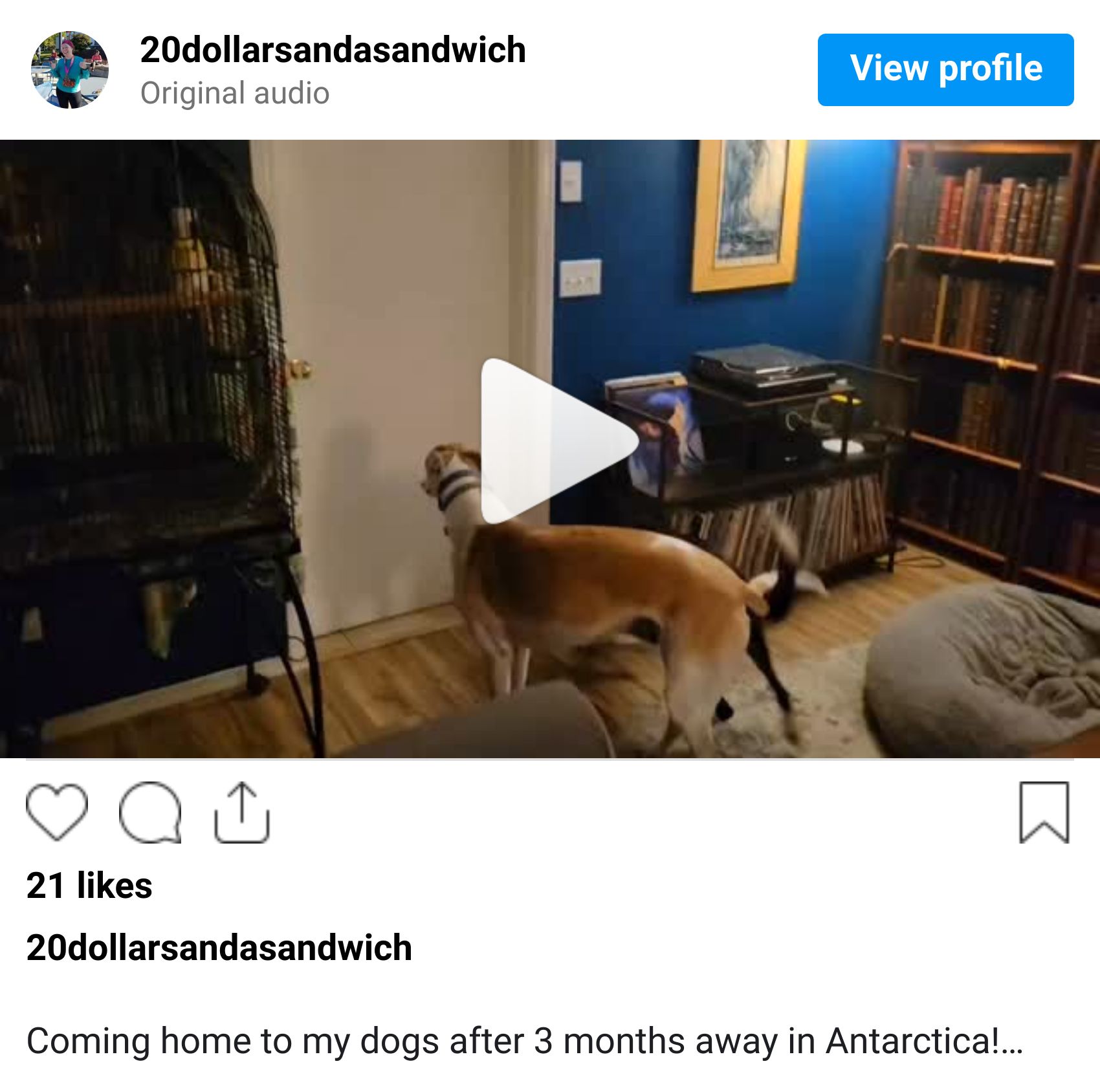
For the first few days, I marveled at how easy everything felt, especially tasks that used to feel like drudgery. It was so luxurious to stay indoors in my pajamas in the morning, instead of immediately having to pull on four layers, boots, and ski goggles just to go to the bathroom. I could shower and wear clean clothes every single day. I could get just about any kind of food I wanted - I could even have it delivered!
And yet, I didn’t feel like my old self. I missed Antarctica, not just the stunning scenery, but also the single-minded focus of fieldwork. I missed the isolation and the slow pace of life. Driving on the highway to work surrounded by people in a hurry, I missed my 15 mph snowmobile commute. I missed not having to think about what to wear, and I still find myself wearing some of my merino wool base layers as regular shirts nearly every day. I gave myself time to adjust, not immediately filling up my calendar with activities, but often that just meant that I didn’t know what to do with myself.
Several people who have done Antarctic fieldwork before have assured me that it took them about a month to reacclimate. I am at the one month mark today, and I guess life does feel more normal now. I’ve gotten back to normal work hours and exercise routines and am starting to be more social again. I am also trying to hang on to some of the good things about my time in Antarctica - especially the slower pace of life, and not trying to multitask all of the time. And I’ll probably keep wearing some of my field clothes even though I don’t really need to.

My home for two months (zoom in to see our camp)